|
DIAMOND TEAMS: aligning professionals to shine
 By Célia Piovan
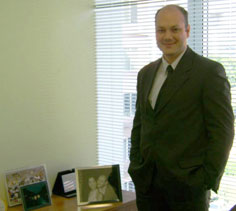
The executive consultant for the pharmaceutical industry, Kleber de Oliveira Miranda, has worked on the operational, marketing and commercial areas for over 14 years concerning development, organizational structure and restructuring in twenty-one countries in Latin America and the Caribbean.
The executive's experience goes beyond, like the establishment of models distribution per market, establishment of Management Systems, Strategy and Regulatory Issues, Intellectual Property copyrights, trademarks and patents, In License, Acquisition, new technologies and office setups in countries like Mexico, Venezuela, Peru and Colombia, as well as a Holding in Uruguay and a Holding Company in Switzerland, among other skills in the area. Professional unique performance together with accurate knowledge about the pharmaceutical market, made him observe the need of creating a new working model, through changes and break of paradigms, aiming at strengthening all the teams' talents to get the best results.
In this edition Kleber Miranda talks about the concept of Diamond Teams, idealized and developed by him.
Top Team: What are Diamond Teams?
Kleber Miranda: They are teams of professionals with empowerment, which multiply know-how, strategies, plans, goals, actions, results, techniques, communication, abilities, efficiency, efficacy, support, innovation, vision, motivation and commitment, through hard team work, partnership synergy, with multidisciplinary features focusing on micromarketing results.
All the pharmaceutical and medical detailing professionals want to succeed, and that's why we have to align them like a "Diamond" in order to generate connections between them and make them unbeatable.
TT: How and why did you create the concept?
KM: I created the model Diamond Team when I was at Sanofi-Synthelabo, in August 1999. At that moment, I had taken over the Center-East Hospital management and intended to make an innovative work with the team that was being formed.
Such team has so far obtained the best results in Brazil, due to the work that started in 1999, conducted by one of the members of the team, who has become a manager, and who I respect and I am proud of.
Since then I have been successful in sales by organizing Diamond Teams.
Nowadays, the District managers have challenges in common to be faced, like promotional alignment, communication, objectives management, leadership, team work, clear goals, development and support
to the team, global strategic vision and micromarketing. On the other hand, sales reps have some wishes in common that cannot be achieved, like professional development, promotional support, talent, professional challenges, be part of a team of winners and have some reward and prizes.
Thus, I realized a new model of work, changes and paradigms breaks, to enhance all the team talent for a maximum result. Within this concept, I had to change some crucial working points like centralized power (Manager)
=> empowerment (team), macro marketing (products manager) => micromarketing (team), centralized management (manager) => participative management (team) and specific skills (medical detailing officer/ sales rep) => multiple skills (medical detailing officer/ sales rep). In order to face competition, companies need to be decentralized and disarticulated. As a consequence, we have to create Plain Structures - structures based on empowerment, participative management, and multiple skills. Besides, both manager and medical detailing officer must develop new skills. Manager should motivate their teams, provide resources, stimulate ideas and think by themselves; meanwhile, officers/ sales reps should multiply their teams´ talent by being part of it with responsibility, discuss and analyze ideas, results and think as a team.
TT: In practical terms, how did you create the concept?
KM: In short, the steps to create a Diamond team are:
1. Establish a Strategic Plan for each District Manager towards the Corporate Strategic Plan. The District Manager should have the sketch of a Strategic Plan in order to fill it in during a meeting. He will coordinate the plan of the team, by having everyone as participants. At the end, this will be the strategic plan for the whole year;
2. Establish a special function for each member of the team, which will turn out to be a new responsibility, besides their regular activities. Such special functions will be delegated by the District Manager to each member of the group. The ideal size of the groups to fit this format fits eight representatives.
TT: Which were the results achieved?
KM: We increased sales of the main hospital product by 750% until May 2001. We reached 33% marketshare, while the national average was16%. The other part of the line has grown nearly 196% in the same period, in the Central Region. We have even been visited by the director of the Hospital Division from Sanofi-Synthelabo for Latin America, which is located in France, just to know our work. The best motivation for the team was to gain respect and good feedback from physicians, boosting results and making the market grow.
At Glenmark, where I worked until November 2008 as a director for Latin America and the Caribbean, we increased sales by 83% in the first semester of 2008, in relation to the first semester of 2007. It is important to observe the sales calendar at Glenmark follows the fiscal calendar of India. Therefore, the first term that we discussed here takes place from April to September.
TT: Do you intend to take the concept to Latin America and the Caribbean?
KM: This model fits perfectly all the companies in Brazil, and for cultural reasons it is easier. It may be applied successfully in Latin American countries, especially the ones that resemble the American Business Administration School like Colombia, Chile, Peru and Mexico.
I see that this model would face great difficulty in Europe, Asia, Africa and the Far-East for cultural reasons, like the centralization of power and management. The same would be applied in Latin American countries and the Caribbean, which follow the European Business and Marketing School trends.
|
|


 Print this page
 Mail this page